 ProductPolish
How to Write Product Descriptions with AI: A Facts-First Workflow
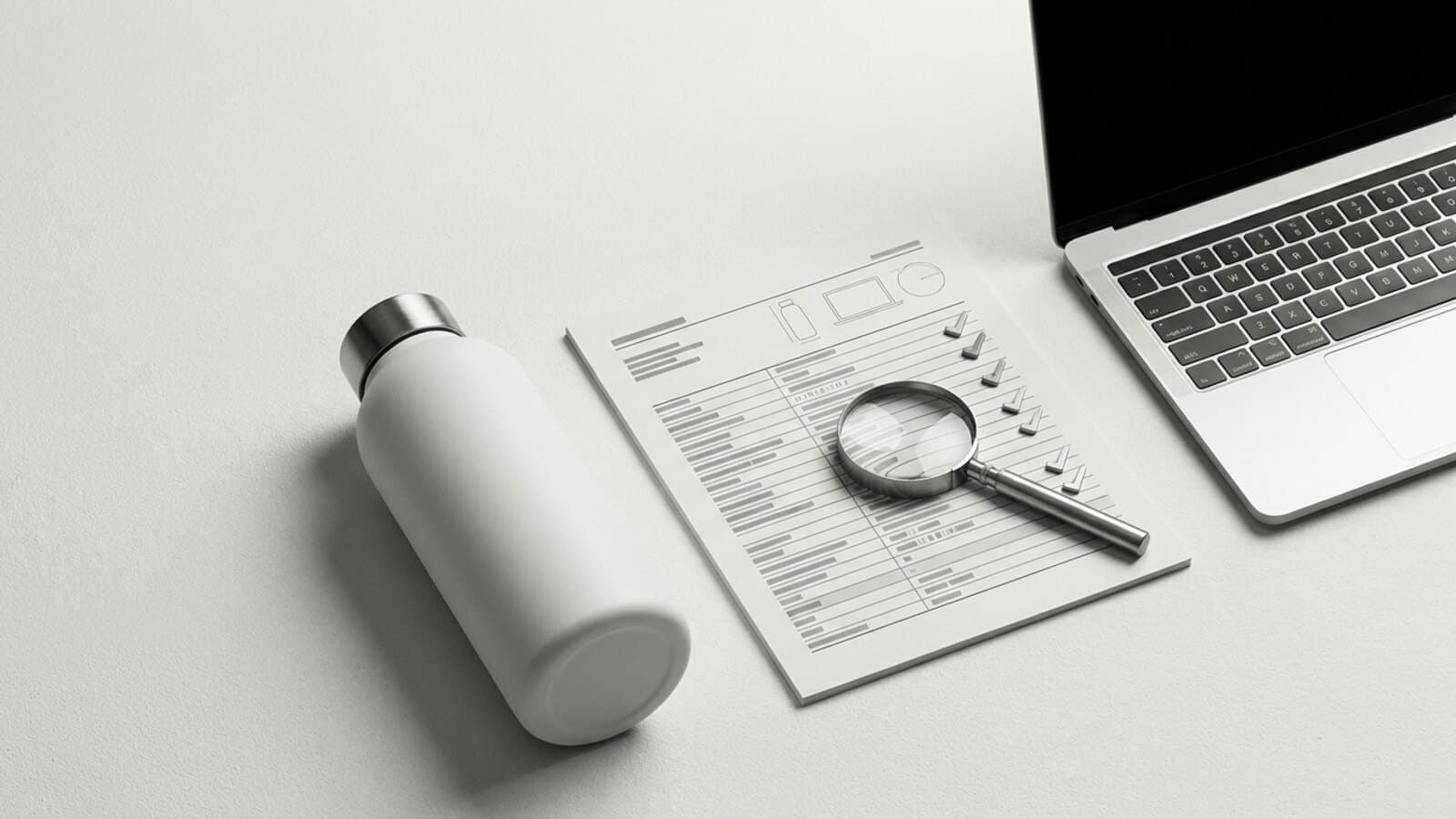
A reliable AI product description follows this order: collect facts, explain buying relevance, apply channel format, check risk. Starting with “write persuasive copy” delegates the exact decisions where errors become expensive.
The core rule: the model may add language, but it may not add product reality.
Why open-ended prompts invent details
Language models try to complete a useful answer. Given only “premium stainless-steel bottle,” an insulation duration, leakproof claim, or dishwasher instruction may sound plausible—none is confirmed.
Shopify warns that generated suggestions can include benefits or facts related to similar products even when a merchant did not provide them. It recommends careful review before publication (Shopify Help Center).
Step 1: Build a product fact sheet
Use fixed fields instead of prose:
| Field | Example | Rule |
|---|---|---|
| Product type | insulated bottle | must be explicit |
| Material | 18/8 stainless steel | copy exactly |
| Capacity | 750 ml | lock number and unit |
| Confirmed features | double-wall body | may be explained |
| Audience | commuters, outdoor users | only if approved |
| Variants | black, sand | map per variant |
| Unknown | insulation duration | do not add |
| Prohibited | “100% leakproof” | never use |
Structured input makes review easier. Shopify likewise recommends a clear product type, multiple concrete features, material, use, audience, and variant information.
Step 2: Separate fact, benefit, and claim
- Fact: “750 ml capacity”
- Permitted translation: “room for longer journeys”
- Unsupported claim: “stays cold all day”
The middle sentence cautiously explains a confirmed fact. The last introduces measurable performance that was never supplied.
Step 3: Define brand voice with testable rules
“Modern and professional” produces average prose. Better rules are observable:
- direct address, active verbs, short sentences
- no exclamation marks
- ban “revolutionary,” “ultimate,” and “game-changing”
- benefit before technical detail
- one idea per bullet
- two approved examples as style references
Step 4: Request finished fields
Using only the confirmed product data, create:
1. product title, max 70 characters
2. short description, 40–60 words
3. long description with two headings
4. five benefit bullets
5. meta description, max 155 characters
6. three FAQs

Mark missing information as [DATA MISSING].
Do not invent dimensions, materials, certifications, effects, or warranties.
These limits are production rules, not universal platform laws. Adapt them to the shop, theme, and feed.
Step 5: Review in risk order
- numbers and units
- materials and package contents
- variant mapping
- absolute wording such as “always,” “guaranteed,” or “100%”
- health, safety, sustainability, and origin claims
- only then readability and tone
What AI shopping systems additionally need
Beautiful prose is not enough for discovery. Google lists size, material, audience, technical details, and visual attributes as useful product information (Google Merchant Center). Shopify recommends specifications, comparisons, structured data, sizing, materials, and care instructions for AI systems (Shopify: Optimizing your store for AI).
Write for people, but do not hide facts behind marketing language.
Approval checklist
- Every number matches its source
- No unknown attribute was added
- Variants remain correctly separated
- The title names the product type
- Every benefit maps to a confirmed fact
- No unsupported guarantees or superlatives
- Metadata matches visible page content
- The copy is original, not a manufacturer duplicate
FAQ
Can AI write a description from a product photo? It can identify visible traits, but it cannot reliably determine materials, dimensions, package contents, or certifications. Vision can supplement a fact sheet, not replace it.
Can hallucinations be eliminated through prompting? Not completely. Reduce them with closed data fields, explicit prohibitions, visible missing-data output, and source comparison.
Do AI product descriptions require a label? Not automatically on the product page. Google Merchant feeds do, however, define structured attributes for AI-generated titles and descriptions.
How long should a product description be? Long enough to answer the buying decision, objections, and relevant facts. Information density and structure matter more than a universal word count.
The best prompt is a clean product-data schema with clear boundaries.
Related reads
Best AI Product Description Tool 2026: 7 Criteria, Not a Ranking
Which AI tool writes the best product descriptions? Seven criteria for merchants: factual accuracy, channel rules, brand voice, batch processing and shop integration.

How to Automate Product Copy for 100 to 10,000 Products
A practical workflow for automating product copy at catalogue scale: data cleanup, templates, batch generation, quality control, and shop publishing.

Amazon Bullet Point Tips: The 5-Point Formula That Works
How to write Amazon bullet points that sell instead of just listing specs. With the 5-point formula, concrete examples, a per-category decision matrix, and anti-patterns.